
The Physics of a Bow Stroke: Modelling Friction on a Violin String
When a violinist draws a bow across a string, something remarkable happens at a microscopic scale: the string doesn't slide smoothly under the bow hair. Instead, it sticks, then slips, then sticks again, hundreds of times per second. This “stick-slip” motion, known as Helmholtz motion, is what gives bowed string instruments their characteristic sound. But capturing this behaviour accurately in a computer simulation has proven to be a surprisingly stubborn problem, and the story of how researchers have tried to model the friction between bow and string is really a story of successive refinements, each solving one puzzle while revealing another.
The simplest picture: friction as a curve
The earliest computational models treated bow-string friction in a fairly intuitive way: friction force depends only on how fast the bow and string are sliding past each other at any given instant. Slower relative sliding means more friction (closer to sticking); faster sliding means less friction. Plot this relationship, and you get a friction curve (see Figure 1). Simple, computationally cheap, and good enough to reproduce the basic stick-slip pattern.
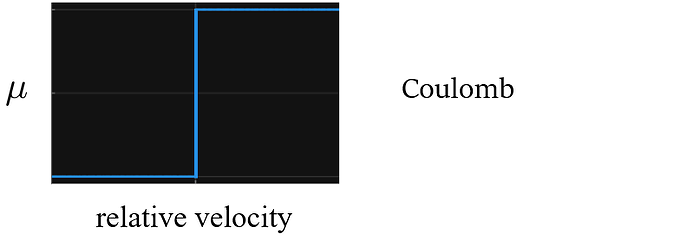
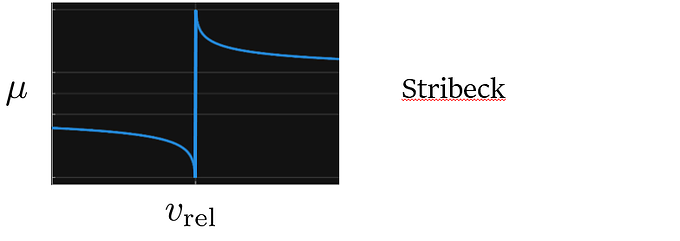
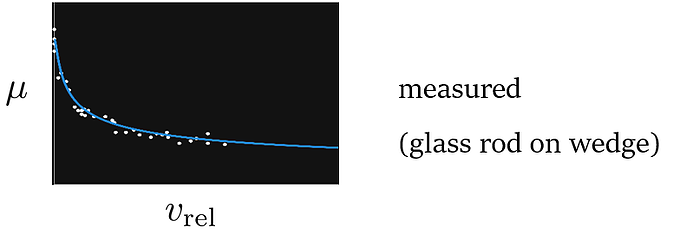
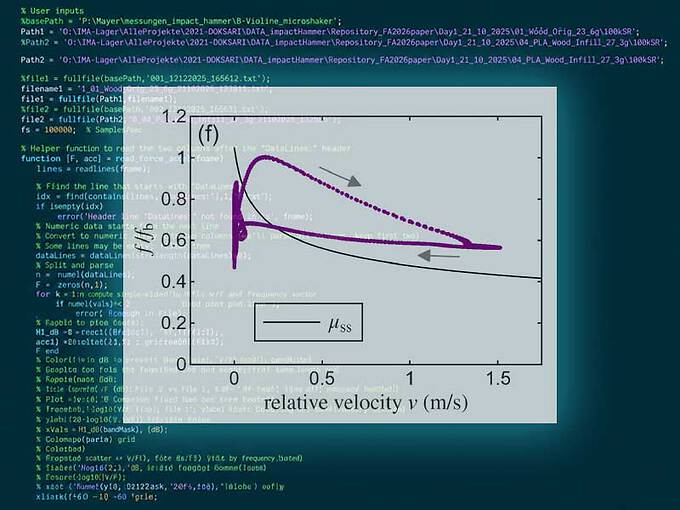
Figure 1. Top/Left: Coulomb friction curve (friction coefficient μ depends only on the sign of the relative velocity between bow and string). Middle: Stribeck friction curve (friction depends on the sign and magnitude of the relative velocity). Bottom/Right: Measured friction curve for a rosin-coated glass rod sliding on a static wedge [J. Smith and J. Woodhouse, (2000) “The tribology of rosin”, Journal of the Mechanics and Physics of Solids 48].
The problem is that real bow-string friction doesn't just depend on the current speed. It also depends on history: how the contact region has been deforming, how hot it's gotten, and how long it's been sticking or slipping. A model that only looks at instantaneous velocity misses all of that, and while it can reproduce the qualitative behaviour, it struggles to capture finer details like transients (what happens in the first fraction of a second, right when the bow starts moving) or how playing conditions push the sound toward less desirable regimes.
A phenomenological approach: bristles and elasto-plasticity
Another generation of models tackled the “no memory” problem head-on. Instead of imagining a single point of contact, these models picture the interface between bow hair and string as a bed of tiny elastic bristles: a “bristle” or elasto-plastic model. As the bow moves, these bristles bend and deform; if they're pushed too far, they yield and slip (see Figure 2).
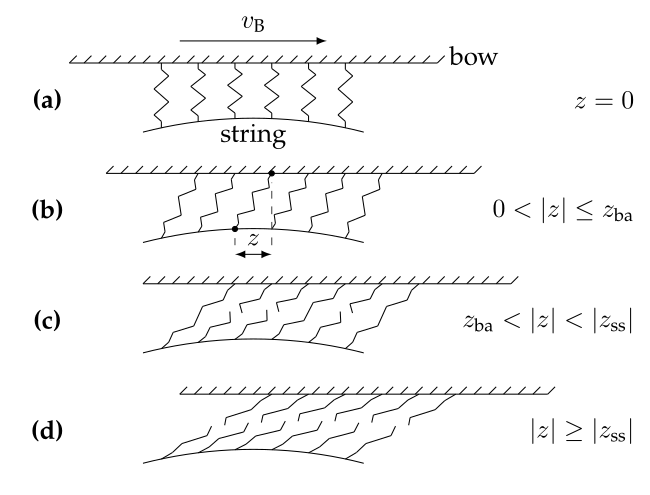
Figure 2. S. Willemsen (2021) “Real-time simulation of musical instruments using finite-difference time-domain methods,” Ph.D. thesis, Aalborg University, Denmark: A visualisation of the microscopic displacements of the bristles between the bow and the string assumed by the elasto-plastic friction model. The bow moves right with a velocity of vB . (a) The average bristle displacement z = 0. (b) The bow moves right relative to the string and the purely elastic, or ‘presliding’ regime, is entered (stick). (c) After |z| gets larger than the break-away displacement zba , more and more bristles start to ‘break’. This is defined as the elasto-plastic regime. (d) After |z| ≥ |zss| all bristles have ‘broken’, the steady state (slip) is reached and the purely plastic regime is entered.
This is a more physically realistic picture, because it naturally produces hysteresis: a kind of “lag” or memory in the friction response, without needing to artificially force the model to jump between states. That being said, these models are typically still tuned by hand for each new playing condition, and, like their simpler predecessors, they leave out something that turns out to matter a great deal: heat.
Why temperature matters: rosin gets sticky and slippery with heat
Violin (and cello, viola, and bass) bows are coated with rosin, a treated tree resin that gives the bow hair the grip it needs on the string. Rosin's mechanical behaviour, though, is highly sensitive to temperature. Friction at the microscopic contact point generates heat, and as the temperature rises, rosin softens and behaves differently. Ignore this thermal effect, and a friction model will miss real changes in behaviour that happen simply because the contact is heating up during play.
This led to a new class of thermal friction models, which introduced a simplified description of how heat builds up and dissipates at the contact point and let that temperature feed back into the friction behaviour. These models captured something the earlier ones couldn't: the way sound and playability shift as the contact region literally warms up during a bow stroke.
Bringing it together: a thermal elasto-plastic model
Each of these approaches solved part of the puzzle but left another part unaddressed: bristle/elasto-plastic models captured memory and hysteresis but ignored heat; thermal models captured heat but lacked the more detailed mechanical picture of contact deformation. The natural next step, recently proposed, is a model that combines both mechanisms: an elasto-plastic bristle-type description of the contact, coupled to a thermal model that tracks how the contact area heats up and cools down, with each affecting the other. Figure 3 highlights some outcomes of this modelling approach.
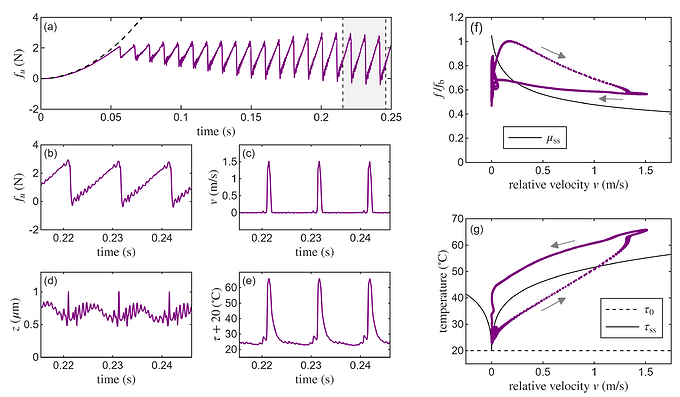
Figure 3: M. van Walstijn, V. Chatziioannou, A. Lampis, and E. Matusiak (2026) “A thermal elasto-plastic friction model for bowed-string simulation,” Acta Acustica, 10, 47, https://doi.org/10.1051/aacus/2026042 : Example simulation result for a single bow stroke. (a) Bridge force. The grey-shaded area indicates a time period of three stick-slip cycles. (b) Bridge force signal for the grey-shaded region. (c) Relative velocity. (d) Bristle displacement. (e) Contact temperature. (f) Effective coefficient of friction versus relative velocity for the grey-shaded region. (g) Contact temperature versus relative velocity for the grey-shaded region; the black dashed line indicates the ambient temperature, and the black solid line shows the steady-state heat-balance mapping.
The hope is that a single friction model, correctly capturing both the mechanical and thermal sides of the contact, can do what earlier models couldn't: reliably predict both the transient “attack” of a bow stroke and its steady, sustained tone across the full range of ways a musician might actually play.
Where things stand
Early results are promising. This combined model can reproduce transient bow-string waveforms across a wide range of playing conditions (see Figure 4 for such an example on a cello G string). But open questions remain, particularly around how the model is calibrated and around some remaining mismatches at the extremes of playing techniques (e.g., very light or very heavy bow pressure). Some of this may come down to needing better ways of measuring what's actually happening at the microscopic contact, including, ideally, the temperature right at the point where bow meets string, which remains extremely difficult to measure directly during play.
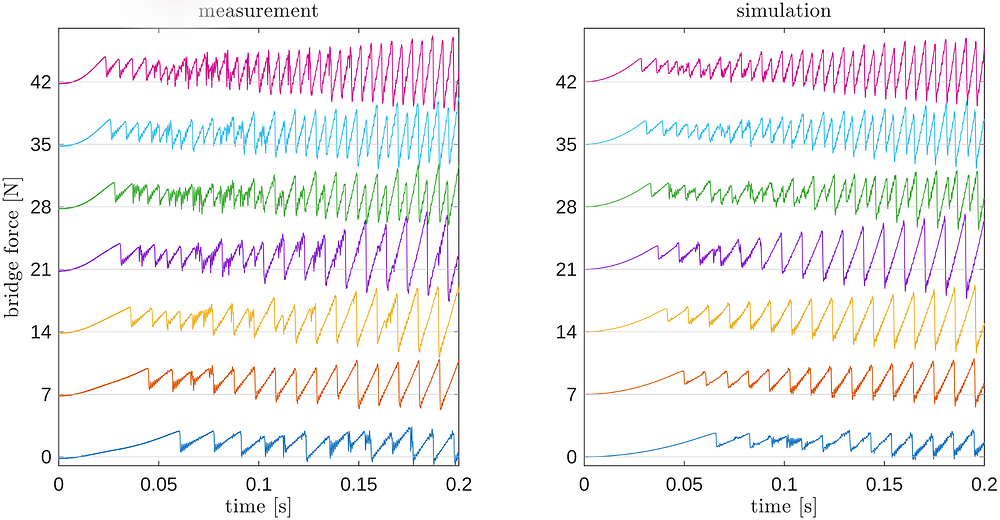
Figure 4. V. Chatziioannou, M. van Walstijn and A. Lampis (2026) “Simulating bow-string transients using a thermal elasto-plastic friction model” in Proc. ISMA, Helsinki: Bridge force waveforms for seven different acceleration values, offset by 7 N for clarity, and a bowing force of 2.74 N.
Bow-string friction, it turns out, is a genuinely hard problem: a prominent, audible effect (the sound of a violin) emerging from processes happening at a microscopic scale, shaped by material properties, temperature, and the almost chaotic sensitivity of the bowed string to tiny changes in how it's played. Each generation of models has gotten closer to capturing that complexity and has clarified just how much complexity is still there to capture.
Bibliography
J. Smith and J. Woodhouse, (2000) “The tribology of rosin”, Journal of the Mechanics and Physics of Solids 48
J. Woodhouse (2026) “The science of musical instruments”, https://euphonics.org
M. van Walstijn, V. Chatziioannou, A. Lampis, and E. Matusiak (2026) “A thermal elasto-plastic friction model for bowed-string simulation”, Acta Acustica, 10, 47, https://doi.org/10.1051/aacus/2026042
V. Chatziioannou, M. van Walstijn and A. Lampis (2026) “Simulating bow-string transients using a thermal elasto-plastic friction model” in Proc. ISMA, Helsink
S. Willemsen (2021) “Real-time simulation of musical instruments using finite-difference time-domain methods,” Ph.D. thesis, Aalborg University, Denmark
Sound examples
single note
vivaldi