Asymmetric Pitch Control in the Vietnamese Monochord Đàn Bầu: Implications for Playing Technique
This web article is a simplified adaptation of the conference paper for Forum Acusticum 2026
by Tim Tarek Grund and Alex Hofmann.
Abstract
We investigated the relationship between pitch and the bending force and displacement on the Vietnamese monochord box zither đàn Bầu. With a load cell mounted on a linear translation device we displaced the bending rod, measured the force at the position of displacement and recorded the sound from the plucked open string. The measurements show an asymmetric relationship between force, displacement and pitch depending on the direction of displacement, which is likely due to the influence of the string tension.
Motivation
Mainstream Music technology has historically and is to this day largely dominated by gestural metaphors taken from Western musical contexts, the prime example being perhaps the concept of a MIDI note modelled after playing a note on a keyboard instrument. We are interested in how we can translate the gestural repertoire of other instruments into engaging musical interfaces. Therefore, we are investigating the đàn Bầu.
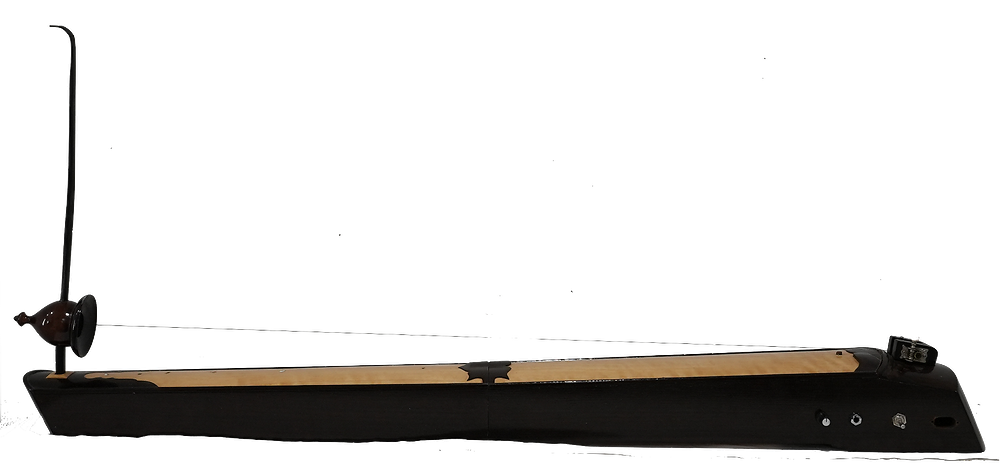
Fig. 2: The đàn Bầu
Introduction
The đàn Bầu is a Vietnamese monochord box zither. A string is tied to a loop and secured around the bending rod on the left side and to a tuning peg on the right. The string is covered by a gourd for ornamental purposes. Our model is an electric đàn Bầu, therefore it also has a pickup, an output connector and a volume knob.
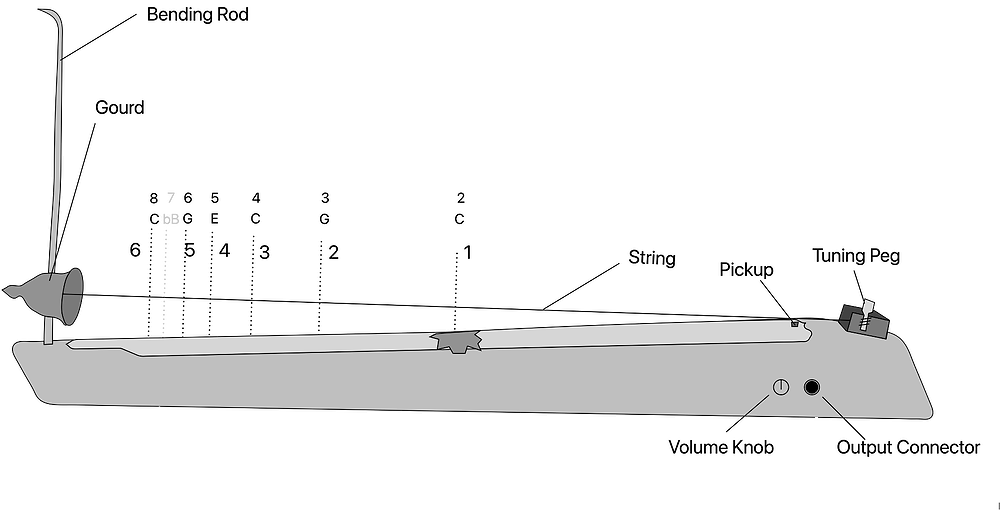
Fig. 3: Schematic of the đàn Bầu
There are two fundamental categories of gestures on the dan bau: those that pluck the string and those that alter the tension and thus the pitch of the string using the bending rod. Plucking is performed in a manner that excites the harmonics by first damping the string at an integer ratio of the length and then plucking upwards using a thumb-long plectrum while releasing the damping.
Bending motions are performed by grasping the rod between thumb and index finger and applying force. This allows performers to play pitches in between, to play scales, as well as adding modulation, vibrato, glissando and other techniques. Typical intervals for the pitch bending are major seconds, minor thirds and perfect fourths. This stems from the folk music tradition the instrument is used in. The upper limit interval for bending outwards is a perfect fourth, for bending inwards the upper limit is a tenth.
To get an introduction to the instrument and its playing technique by a professional đàn Bầu player, we recommend the following videos:
- Pham, Tam Thi, and Ngo, Tra My. (2023, February 23).
Lesson 2: Notes in neutral positions of the rod (hand positions): Video link to external site - Pham, Tam Thi, and Ngo, Tra My. (2023, February 25).
Lesson 3: Introduction to intervals and learning major second: Video link to external site
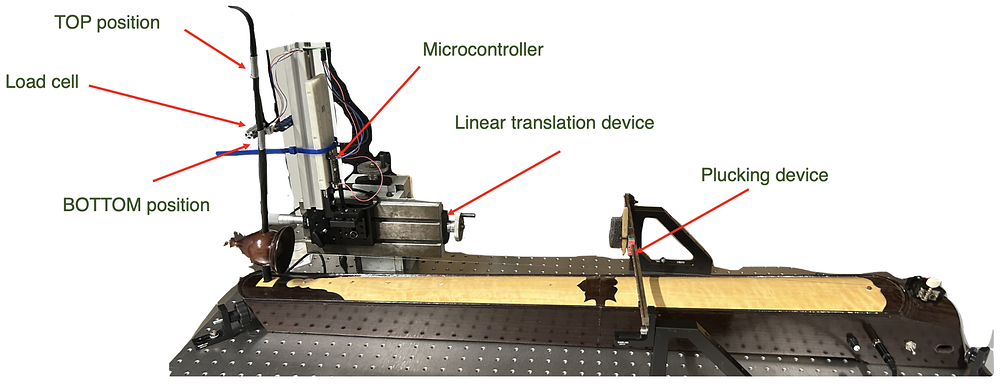
Fig. 4: the measurement setup
Method
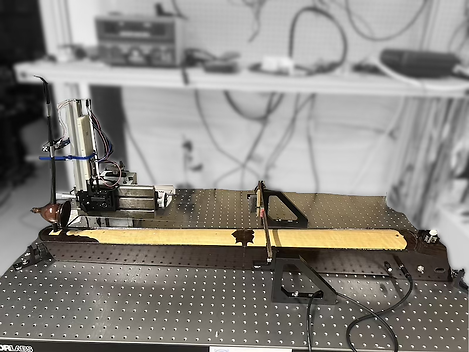
We used the following measurement setup (see Fig. 4): A linear translation device moves a load cell which touches the bending rod inwards or outwards. This flexes the bending rod, which increases or decreases the string tension and thus increases or decreases the pitch. We measured at 2 different positions on the rod to capture a range of possible hand positions and displaced the bending rod in 5 mm increments. With a plucking device, we excite the string. The sound is recorded through the output connector and analysed to find the pitch.
Results
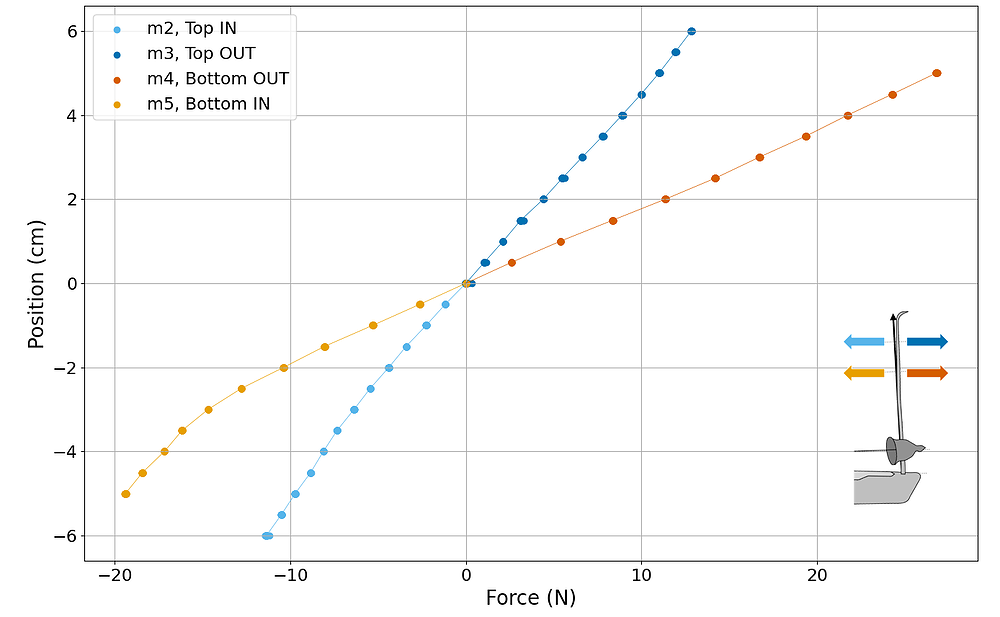
The relationship between Displacement versus Force looks linear for the largest part, with pronounced kinks in the far end of the negative force area. Two things can be seen from this:
- A positive force (bending the rod outward) needs a greater magnitude to displace the rod compared to a negative force (bending inward).
- The Top position has a steeper curve than the Bottom position, so it requires less force for the same displacement, likely due to bending rod acting as a lever.
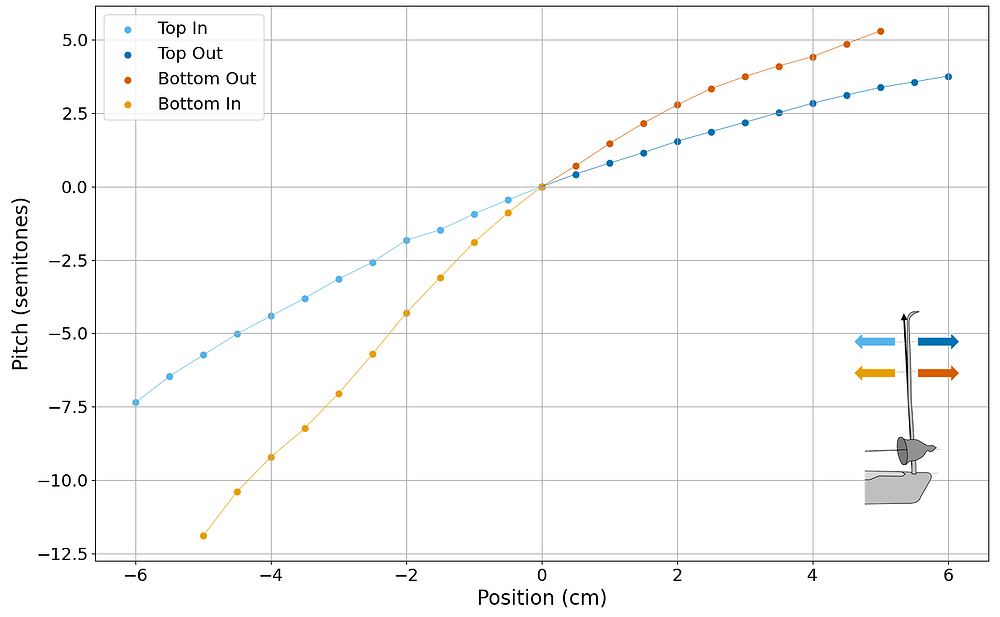 Fig. 6: Pitch versus Displacement
In Fig. 6 the pitch difference in semitones are plotted against the displacement, in order to get a more musical understanding of the implications of the bending interaction. For the half of the plot showing a negative displacement, the curves appear almost linear, and bend to the right for the positive half of the displacement range. We can see that
- the direction of displacement affects the pitch magnitude of the pitch change: Bending into the instrument (negative displacement) requires less displacement for the same pitch change, and
- for a higher bending position, the magnitude of the pitch change is weaker at the same magnitude of displacement.
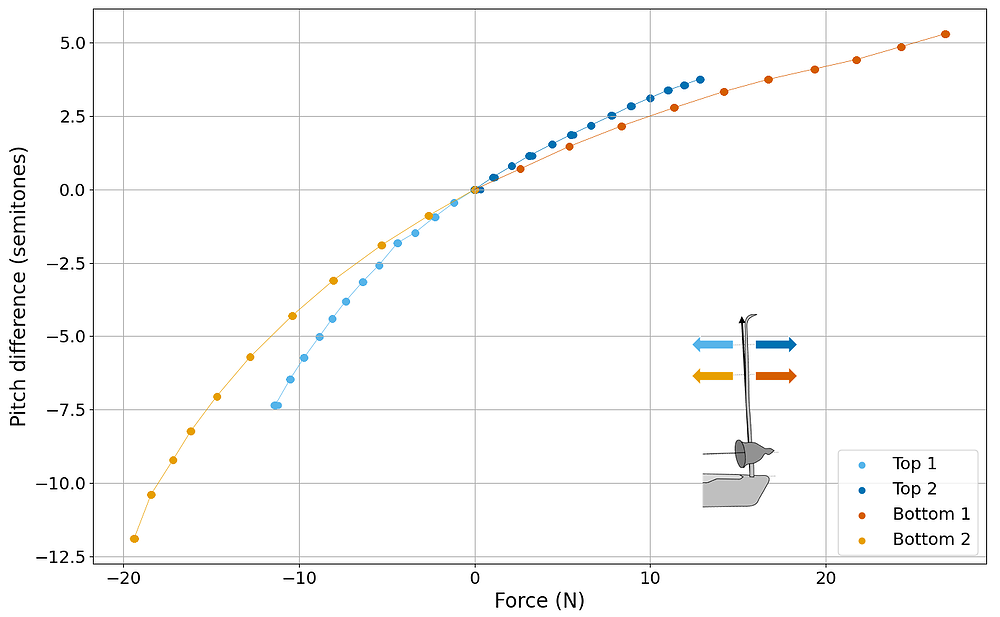 Fig. 7: Pitch versus Force
The relationship between the pitch and the bending force seems to follow a half parabola. In this perspective as well as in the one before, the direction of bending affects the magnitude of the pitch change. Bending with the same amount of force into the instrument results in more than double the magnitude of pitch difference in semitones compared to outwards.
To sum up the bending interaction on the đàn Bầu: There is less force needed to displace the bending rod towards the instrument and there is less displacement and less force needed for the same pitch change.
Outlook
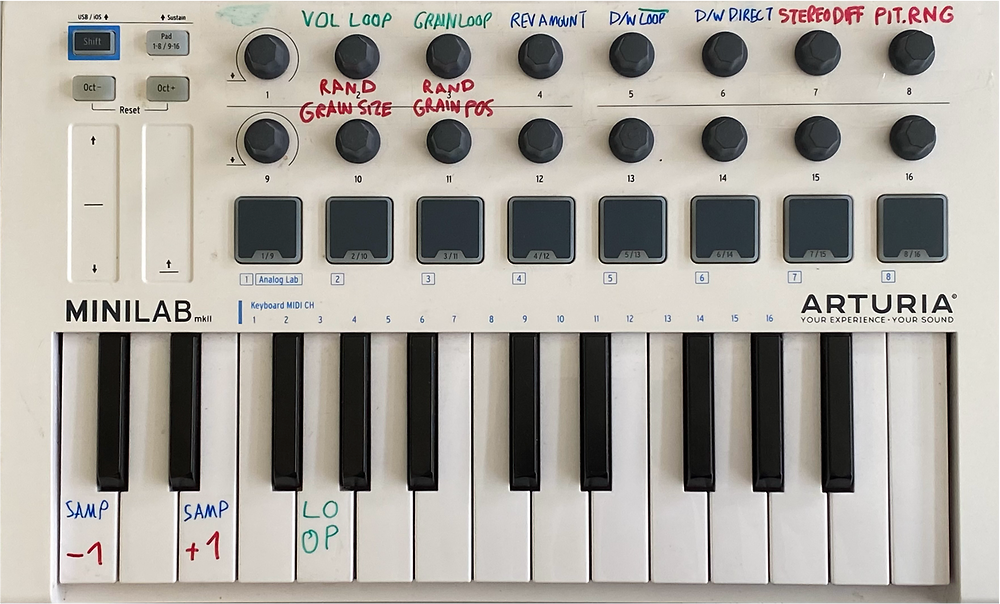
Previously, we had already built a gestural controller for live-electronics that is based on the gestural repertoire of the đàn Bầu, the Grain Bau. With these measurements, we can inform and build a new version of its pitch controller, which should be closer to the feel of the đàn Bầu.