A comparative study of 3D-printed cello bridges
Which one comes closest to the original made out of wood?
This web article is a simplified adaptation of the conference paper for Forum Acusticum 2026
by Alexander Mayer and Montserrat Pàmies-Vilà.
Abstract:
The differences between 8 3D-printed bridges, which were fabricated using various 3D-printing technologies, materials and internal structures, were explored and compared to the original wooden cello bridge. Input admittance measurements were used to investigate how the different bridges affect the resonance characteristics of the bridge–body system. Input admittance, coherence and speed of sound within the tested bridges are compared amongst materials. The findings provide a foundation for the further development of a 3D-printed sensor-equipped bridge.
Motivation
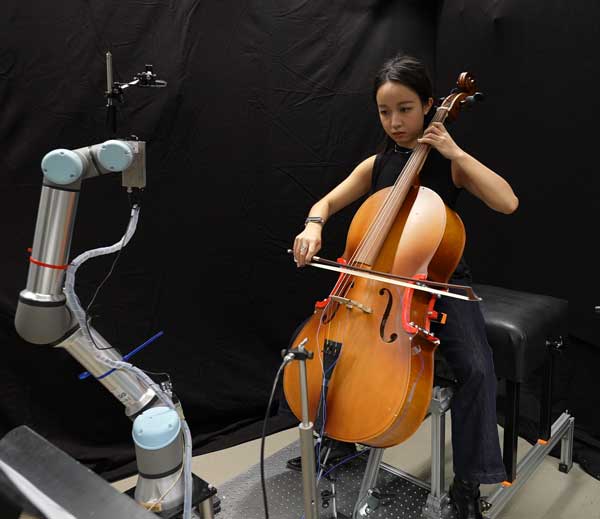
The idea for this study arose from two previous projects. In one study we were able to gain experience of how an industrial robot can be used to reproduce human bowing gestures. From the second project we were able to draw valuable insights on the sensor technology used. Which led to the development of a 3D-printed sensor bridge prototype. The bridge is certainly playable, but with a weight of around 71g, it is about three times as heavy as the original wooden bridge. Therefore a rapid prototyping method and bridge model should be identified that largely replicates the characteristics of the original, whilst offering the advantages of easy integration of electronic components and sensors.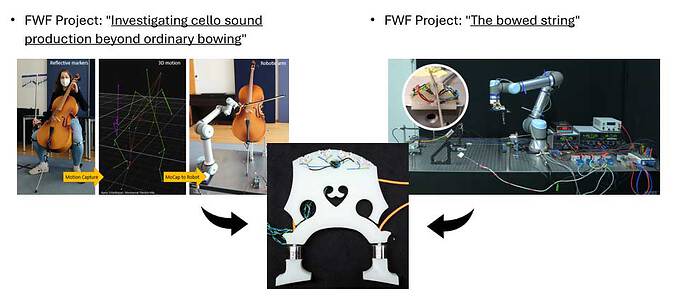
Fig. 1: The "Sensor-Bridge" - the idea for this study arose from two previous projects.
One shape – nine different properties
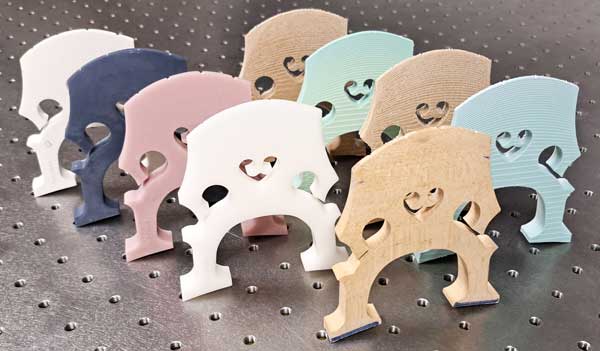
We had two 3D printing technologies at our disposal. On the one hand we used the common FDM -Fused Deposition Modelling technology (that’s the one with the plastic filament). Two different PLA materials and two different infill variations were chosen for comparison. On the other hand, the technology of Masked Stereolithography came into use. (In this process, a liquid photopolymer is exposed to light and cured layer by layer). For bridge 8 the 3D Model was modified to a partially hollow version for weight reduction (-31% in Volume). Only Bridge Nummer 9 was printed externally and was used as round off the set as it represents the heaviest bridge in the test series.![on the left: foto of 9 cello bridges, nubered according to the table on the right, on the right: A table compares nine material samples (labeled 1–9) by material, fabrication method, and weight in grams. Entries include: Maple via wood craft—23.6 g; PLA via FDM (40% infill)—33.5 g; PLA via FDM (99% infill)—44.9 g; PLA-wood via FDM (40% infill)—27.3 g; PLA-wood via FDM (99% infill)—36.4 g; Resin via MSLA (solid)—44.7 g and 44.9 g; Resin via MSLA (hollow)—30.9 g; Digory (Resin) via SLA (solid)—59.8 g. Column headers are “Material,” “Fabrication,” and “Weight [g].”](https://www.mdw.ac.at/upload/MDWeb/iwk/img/oneshape_gr.png)
Towards assuring reproducibility
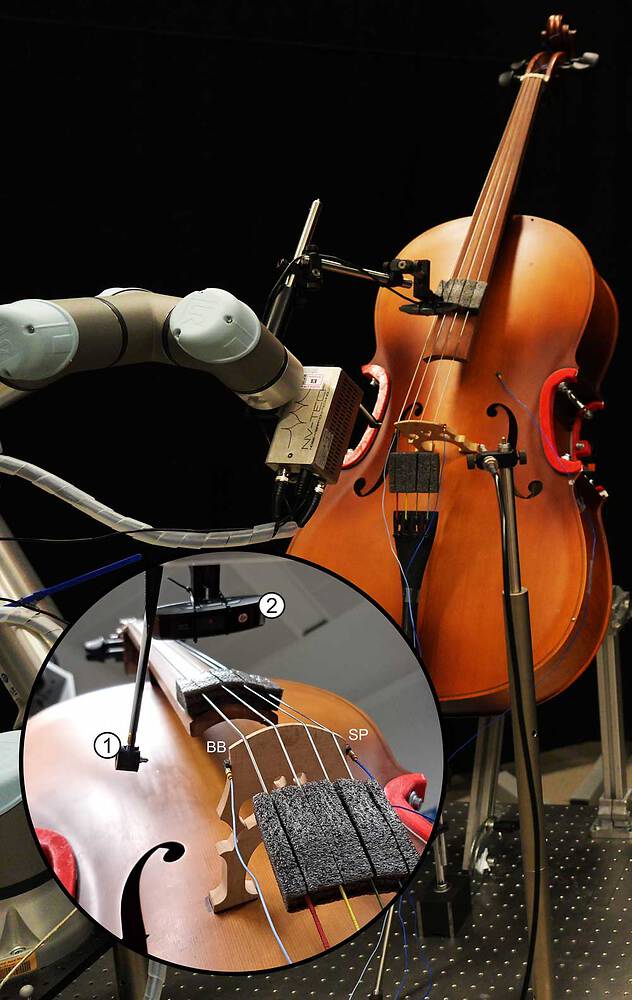
The fixed cello setup from the previous mentioned project was reused. This time the robotic arm served only as a precise, movable stand to hold an automatic impact hammer mechanism for taking admittance measurements. When the bridge had to be changed, the impact hammer was moved away from its position and flipped back if needed. For capturing the response from the impact, accelerometers are mounted on both sides of the bridge. We mounted 3 laser pointers to provide optical markers for bridge positioning. A webcam, mounted on the robotic arm, in conjunction with a picture overlay feature of a stop-motion video software was used for additional control of the bridge and sensor positioning during the whole setup of bridge sequence.
- Robotic arm moves/returns impact hammer (1) and webcam (2) to exact positions for each test
- Laser markers (SP point + feet lines) and hammer tip aiding precise bridge placement
- Video live-overlays to align reattached bridge and accelerometers
- Automated impact hammer system
Results of the input admittance measurements
The graph on the top represents the 10 admittance curves of the wooden bridge all printed on top of each other – as in between the measurements no changes in the setup were done, it is obvious that the measurements are mostly identical. The coherence factor curve (that’s the orange curve) stays close to 1, indicating a strong causality.
In the bottom graph the measurement of all 6 times, 60 measurements in total, are plotted. Of course, a higher variability can be observed, as well the coherence drops, but remains mostly in an area higher than 0.8 over most of the spectrum. We observed a consistent behaviour for all tested bridges.
![A table compares nine material samples (labeled 1–9) by material, fabrication method, and weight in grams. Entries include: Maple via wood craft—23.6 g; PLA via FDM (40% infill)—33.5 g; PLA via FDM (99% infill)—44.9 g; PLA-wood via FDM (40% infill)—27.3 g; PLA-wood via FDM (99% infill)—36.4 g; Resin via MSLA (solid)—44.7 g and 44.9 g; Resin via MSLA (hollow)—30.9 g; Digory (Resin) via SLA (solid)—59.8 g. Column headers are “Material,” “Fabrication,” and “Weight [g].”](https://www.mdw.ac.at/upload/MDWeb/iwk/img/result1_original.png)
Comparison of input admittance
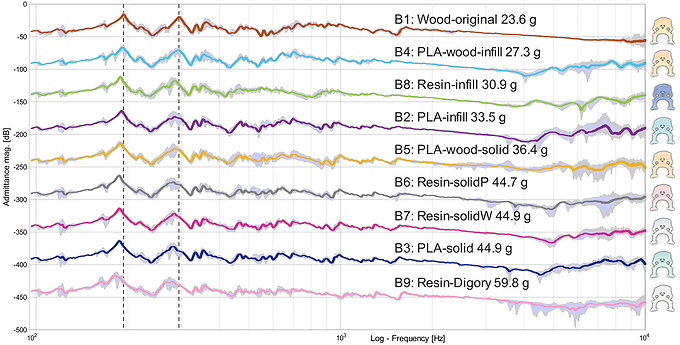
In the graph above the mean admittance curves ordered according to bridge weight, is presented. A separation by -50 dB is added for a better visualisation. The shaded zone is given by the maximum and minimum values per frequency beam among all measurements. Vertical dashed lines indicate the frequency of the first and second resonance peaks of bridge 1. Clearly a tendency can be observed; the heavier the bridge the lower the frequency of these two peaks.
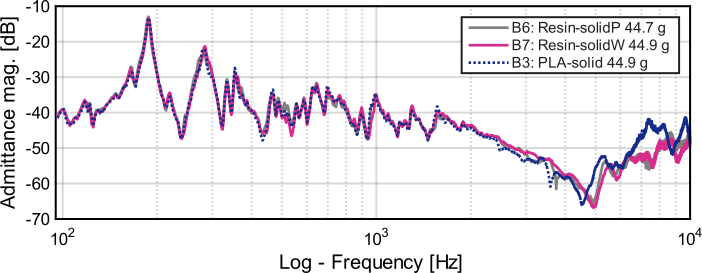
In Fig.6 the admittance of three bridges of roughly the same weight are ploted: two made of resin, and one made of PLA filament. Although made from a different material and using a different manufacturing method, the differences in the measured admittances are minimal.
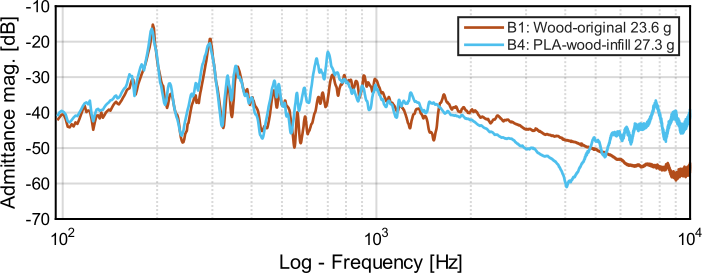
When we compare the lightest 3D-printed bridge with the original wooden – with a weight difference of less than 4 grams – we observe good agreement in the resonance behaviour up to approximately 500 Hz. Interestingly, in the frequency range above this, clear differences can be observed (see Fig. 7).
Speed of wave propagation
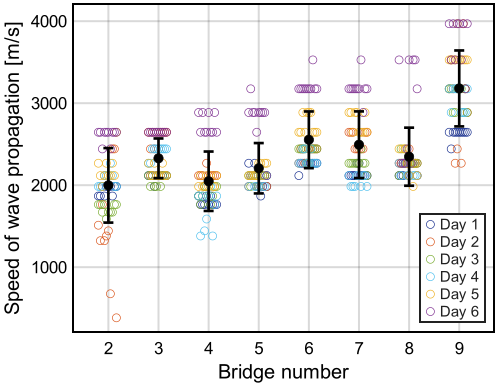
As we had fitted acceleration sensors on both sides of the bridge, we had the idea of checking of how long it would take for the impact signal to travel from one side to the other. As an example, the time signals from 10 measurements at a sampling rate of 500 kS/s for Bridge 3 are shown in Fig. 8.
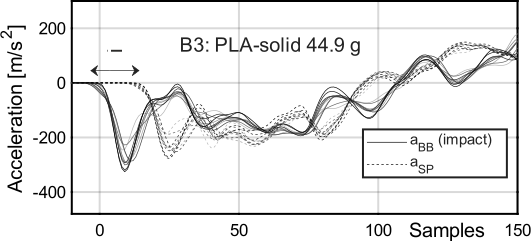
When all the calculated values are compared in a plot (see Fig. 9 we observe the tendency, that the speed of wave propagation is slightly lower for the PLA bridges than the ones made from resin. The values are consistent with those given in literature. Bridge 1 is not shown, as the values obtained were significantly higher (8015.9 ± 1160.3 m/s ). To minimise quantisation or measurement errors, we repeated the measurement on the wooden bridge at 1 GS/s and obtained values of the same order of magnitude – these, too, are comparable with the values reported in the literature. What is noteworthy in the graph is that the values from the measurements on day 6 are consistently higher. After reviewing the raw measurement data again, a slightly higher impact force of the hammer could be a cause – however, to prove this nonlinear behaviour, a far more detailed and specifically designed study would be required.
Conclusions
- General trends in the admittance curves appear to be primarily attributed to weight.
- Meticulous handling, and extensive number of measurements involved, the findings are considered highly reliable.
- The study identifies a potential candidate for further development of sensorised 3D-printed bridges.
- Preliminary bowing test conducted with a professional musician: all bridges proved to be playable.
- The PLA-wood bridge with 40% infill most closely resembled the original bridge.
All the data collected for the analysis, as well as the programme code used for data analysis, can be found on Zenodo at https://doi.org/10.5281/zenodo.20797148