
Studying the playability of bowed strings with a robotic arm
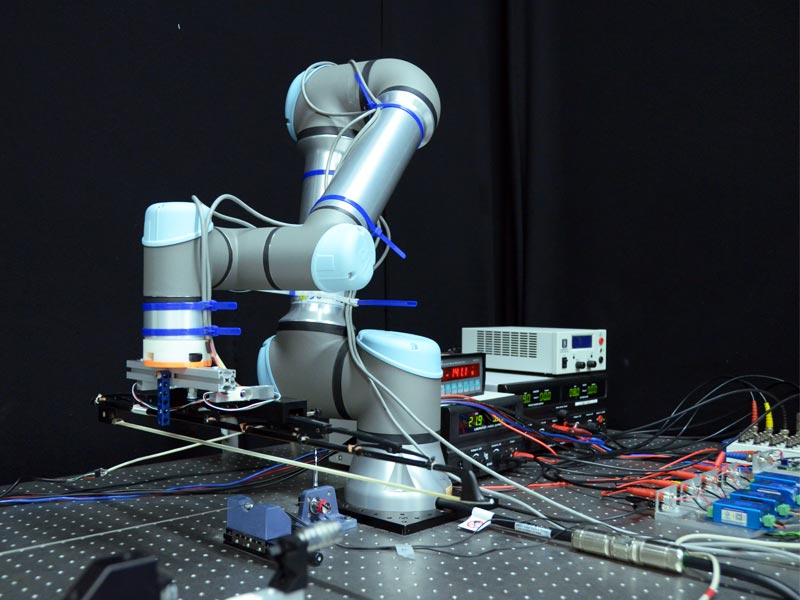
This web article is a lay-language adaptation and extract of the phd thesis from Alessio Lampis that took place within the FWF project "The bowed string":
Abstract:
Every cellist knows the feeling: the right amount of pressure, the right speed, the right spot on the string, and the note sings. Get any of these wrong, and the sound scratches, whistles, or simply refuses to start. What makes this balance work, and why it sometimes fails, is one of the oldest questions in musical acoustics. At the Department of Music Acoustics (IWK) of the University of Music and Performing Arts Vienna, we have been tackling it with an unusual collaborator: an industrial robotic arm.
Context:
The sound of a bowed string instrument originates from a vibration pattern that depends critically on a few physical parameters: the force of the bow on the string, the speed at which it moves, and the position along the string where the contact occurs. These three quantities define the so-called bowing parameter space, and the regions within this space where the string produces a musically acceptable tone have been studied theoretically since the work of Helmholtz in the 1860s. Yet, mapping these regions experimentally, with enough resolution and repeatability to test the existing theories, remains a technical challenge. At the Department of Music Acoustics (IWK) of the University of Music and Performing Arts Vienna, a doctoral research project addressed this problem using a robotic arm as a bowing device, producing one of the most extensive experimental datasets on bowed-string playability to date.
The setup:
The core of the experiment is a single cello string mounted between two sensing terminations on a heavy, vibration-isolated optical table, in what acousticians call a monochord configuration. A UR5e robotic arm by Universal Robots draws a cello bow across the string, while force sensors at both ends record the vibration, and load cells on the bow measure the contact force. The robot can repeat the same gesture thousands of times with a high positioning repeatability, allowing a systematic investigation of the parameter space that no human player could achieve. Because the string sits on rigid supports rather than a cello body, the vibration we observe comes purely from the string itself, free from the added complexity of body resonances. Full technical details of the apparatus are given in Mayer and Lampis (2024).
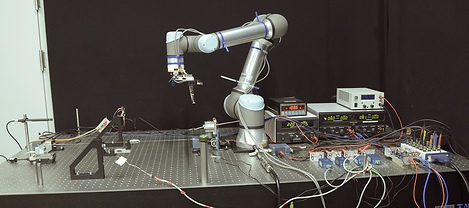
Figure 1: The experimental setup at the IWK laboratory. A cello string is mounted on a vibration-isolated optical table, with the UR5e robotic arm positioned for bowing. Force sensors at the string terminations and on the bow measure vibration and contact force simultaneously.
Mapping the playable region
When a bow sustains a note, the string vibrates in a characteristic pattern called Helmholtz motion, discovered by Hermann von Helmholtz in the 19th century. This is the vibration behind the normal singing tone of a bowed instrument. Helmholtz motion requires the right combination of bow force and bowing position: too little force, and the string slips in an uncontrolled way; too much, and the vibration becomes rough and noisy. These boundaries are visualized in a Schelleng diagram, named after the physicist John Schelleng, who derived the first theoretical expressions for these limits (Schelleng, 1973). Our experiments produced high-resolution Schelleng diagrams with several thousand data points per diagram, and the measured limits broadly agree with Schelleng's classical predictions, though systematic deviations appear that expose the simplifications behind the theory (Lampis, Chatziioannou, & Scavone, 2025).
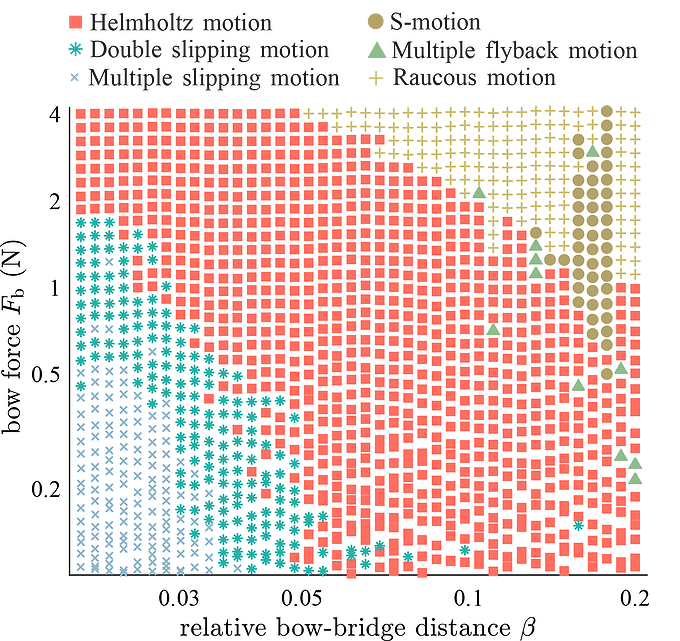
Figure 2: Experimental Schelleng diagram for a cello G string. Each point represents one bow stroke; color indicates the identified vibration regime. The region of Helmholtz motion, corresponding to the normal playing tone, is bounded by upper and lower bow force limits
The quality of the attack
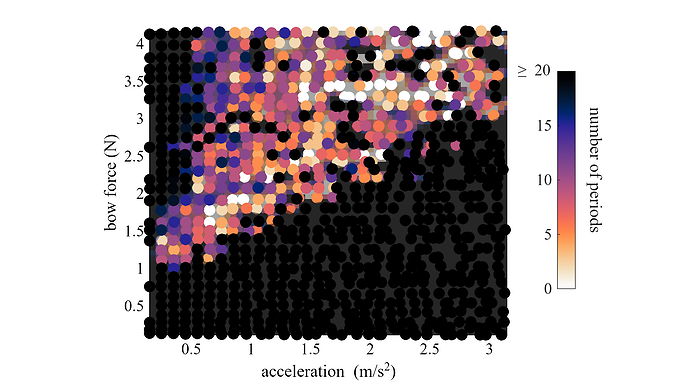
Starting a note cleanly is a different problem. When the bow first touches the string, the vibration needs to settle into Helmholtz motion as quickly as possible. A slow or rough onset is audible even to untrained listeners, and musicians spend years refining their control of the attack. We mapped this transient behavior in a Guettler diagram, which shows how the duration of the initial transient depends on the bow force and the acceleration at the start of the stroke. Theory predicts that successful attacks should cluster within a triangular region of this parameter space (Guettler, 2002). Our measurements confirm the existence of this region, but the internal picture is far less tidy: neighboring parameter combinations often produce either a clean attack or a failed one, reflecting the inherently chaotic nature of bowed-string transients. This behavior had been observed before only by Galluzzo (2004), and our higher-resolution data confirm and extend his findings (Lampis, Mayer, & Chatziioannou, 2024a).
Do strings make a difference?
A question that interests both scientists and musicians is whether different strings, made with different materials and constructions, behave differently under the bow. In collaboration with the string manufacturer D'Addario, we tested cello G strings with solid steel, stranded steel, and nylon cores, at two different tensions, producing Schelleng and Guettler diagrams for each. The differences are real and measurable. Damping turns out to be the most important property for sustaining stable vibration: moderately damped strings offer the widest range of playable bow forces. For the attack, bending stiffness matters more: stiffer strings take longer to develop Helmholtz motion. The tonal character also varies, with steel cores producing brighter sounds and nylon cores showing more pitch sensitivity at higher bow forces (Lampis, Chatziioannou, & Scavone, 2025; Lampis, Mayer, & Chatziioannou, 2024b).
What happens at the contact point?
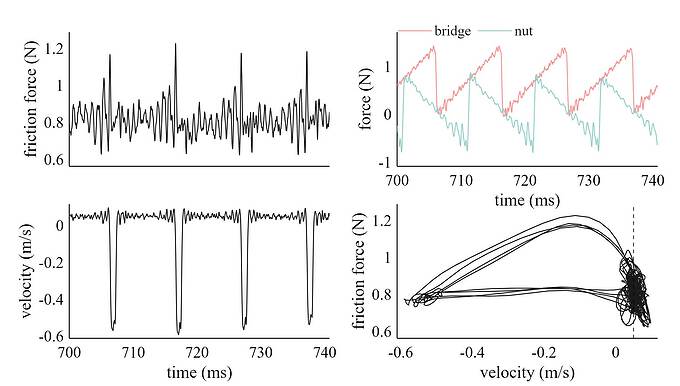
The friction force between bow and string is what drives the vibration, but it cannot be measured directly without disturbing the very phenomenon one wants to observe. We applied a reconstruction method, originally developed by Woodhouse, Schumacher, and colleagues (Woodhouse et al., 2000; Schumacher et al., 2005), that calculates the friction force and the string velocity at the bowing point from the forces recorded at the two ends of the string. In this work, the method was extended to account for the finite width of a real bow, enabling friction force reconstruction under realistic conditions for the first time on a cello string. The reconstructed friction-velocity trajectories reveal how the stick-slip cycle, the back-and-forth grip and release between bow hair and string, differs across vibration regimes.
Looking ahead
This experimental platform provides a controlled, repeatable, and versatile tool for bowed-string research. The datasets collected during this project, comprising tens of thousands of individual bow strokes, are being made publicly available through Zenodo repositories for use by the wider research community, for instance in validating and improving numerical simulation models. Recent work at the IWK has already used the same robotic arm to replicate the bowing gestures of real cellists, recorded through a motion capture system (Pamies-Vila et al., 2024), bringing the experimental approach one step closer to actual musical performance.
This research was carried out at the Department of Music Acoustics (IWK) of the University of Music and Performing Arts Vienna. Funded by the Austrian Science Fund (FWF), project P34852-N.
References:
Galluzzo, P. (2004). On the playability of stringed instruments [Doctoral dissertation, University of Cambridge]. Guettler, K. (2002). On the creation of the Helmholtz motion in bowed strings. Acta Acustica united with Acustica, 88(6), 970-985.
Lampis, A., Chatziioannou, V., & Scavone, G. (2025). Experimental analysis of cello string types: Influence on playability and tonal characteristics using Schelleng diagrams. Proceedings of Meetings on Acoustics, 58, 035013. https://doi.org/10.1121/2.0002111
Lampis, A., Mayer, A., & Chatziioannou, V. (2024a). Assessing playability limits of bowed-string transients using experimental measurements. Acta Acustica, 8, 44. https://doi.org/10.1051/aacus/2024055
Lampis, A., Mayer, A., & Chatziioannou, V. (2024b). An experimental approach for comparing the influence of cello string type on bowed attack response. JASA Express Letters, 4(11), 113201. https://doi.org/10.1121/10.0034330
Mayer, A., & Lampis, A. (2024). A versatile monochord setup: An industrial robotic arm as bowing and plucking device (IWK Tech Report 1-2024). Department of Music Acoustics, University of Music and Performing Arts Vienna. https://doi.org/10.21939/iwk-tech-report-1-2024
Pamies-Vila, M., Mayer, A., Matusiak, E., & Chatziioannou, V. (2024). A method for the reproduction of cello bow kinematics using a robotic arm and motion capture. Acta Acustica, 8, 45. Schelleng, J. C. (1973). The bowed string and the player. The Journal of the Acoustical Society of America, 53(1), 26-41.
Schumacher, R. T., Garoff, S., & Woodhouse, J. (2005). Probing the physics of slip-stick friction using a bowed string. The Journal of Adhesion, 81(7-8), 723-750. Woodhouse, J., Schumacher, R. T., & Garoff, S. (2000). Reconstruction of bowing point friction force in a bowed string. The Journal of the Acoustical Society of America, 108(1), 357-368.