
Performance and Paper Presentation at ICSC 2026
Written on October 20th, 2026 by AH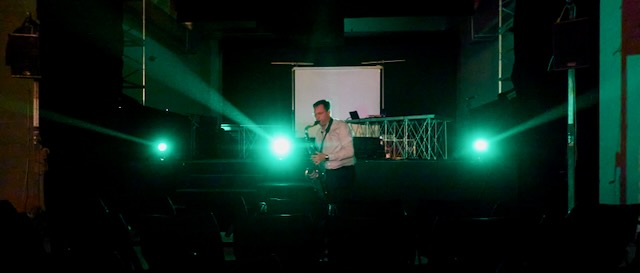
Image: Alex Hofmann performing “Bella Tenor” at the International Csound Conference 2026. (Photo by Iain McCurdy.)
Performance: Bella Tenor
Alex Hofmann, Composer & Saxophone MIXED · 10’00”
Bella Tenor (2018) is a work for tenor saxophone and embedded Csound live-electronics that uses algorithmically organised verbal instructions to guide an improvisation. A Csound patch thereby plays the instructions for parameters like dynamics, duration, sound content, register, and tempo, to shape the performance without fixed notation. All electronics are built as a portable setup into the saxophone, including microphone, loudspeaker, and a Bela board. The sound is processed in real time using the COSMO library and played back through the loudspeaker in the saxophone’s bell, blending acoustic and electronic sound.
Paper: A Rapid Opcode Development Workflow for Real-Time Physical Modelling in Csound
Following a two-month summer internship at the IWK, Juliette Tudoce from Le Mans Université (France) presented the research outcomes of the case study “Physical Modelling of the Vietnamese Dan Bau” at the International Csound Conference 2026, held in Trapani from 20–22 October. The paper was a collaboration between Juliette Tudoce, Vasileios Chatziioannou, and Alex Hofmann.
Juliette Tudoce, Vasileios Chatziioannou, and Alex Hofmann
Abstract: Implementing a custom physical modelling opcode in Csound requires fluency in C programming, a skill that remains a significant barrier for many musicians and researchers in music acoustics, despite the strong potential of physics-based sound synthesis. This paper presents a development workflow for creating a Csound opcode, illustrated through the case study of the Đàn Bầu, a Vietnamese monochord instrument plucked by the right hand and pitch-bended by the left hand through a stem that modulates the tension of the string. Starting from a generic string model drawn from the acoustics literature, we first prototyped it in Python, allowing for straightforward implementation and assessment of the energy balance. We then translated the Python code into C with the help of Large Language Models (LLMs), which produced a functionally correct translation in a single pass. Finally, the resulting C code was manually adapted into an opcode plugin, enabling its integration into Csound. This case study suggests that the complete process from mathematical model to performable instrument through Csound can be achieved without deep C-programming expertise. The workflow presented here offers an illustrative example that musicians and researchers in music acoustics may draw on when developing other physical modelling opcodes for real-time implementation in Csound.
Find the full paper here: Tudoce, J., Chatziioannou, V., Hofmann, A. (2026) A Rapid Opcode Development Workflow for Real-Time Physical Modelling in Csound. In Proceedings of the 8th International Csound Conference (ICSC 2026), pdf